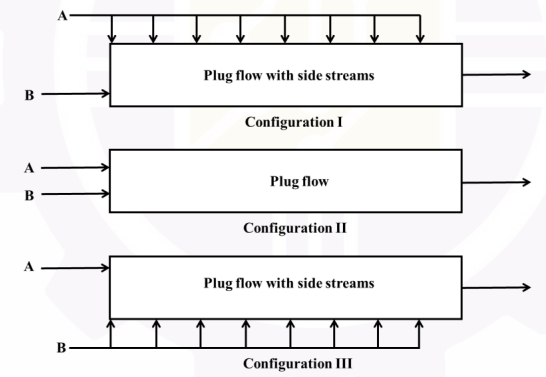
Consider the following homogeneous isothermal liquid-phase parallel reactions carried out in three reactor configurations (having identical volumes and same operating temperatures), as shown in the figure.
where D is the desired product and U is the undesired product. The inlet concentrations of A and B are the same in all three configurations (). The total molar feed flow rate of A () and that of B () are the same in all three configurations (). In configuration I, is equally distributed among all the inlets. Similarly, in configuration III, is equally distributed among all the inlets. Assuming plug flow behavior, at steady state, which one of the following statements is CORRECT?
Loading peer stats…
💡 Want to save your progress, build a mistake book, and sync across devices? Log In / Register for free!